Adjustable Beds & Mattress Compatibility
Will a Latex Mattress Bend with an Adjustable Base? What to Check
Latex is resilient, springy and often associated with long-lasting support. But a mattress that rebounds well on a flat bed is not automatically suited to a frame that bends. Before pairing a latex mattress with an adjustable base, check the mattress maker’s guidance, the mattress construction and dimensions, and the base’s own requirements.
Published November 2, 2026
The question sounds straightforward: can a latex mattress bend when an adjustable bed raises the head or feet? In many cases, a flexible mattress may be able to move with an adjustable base. Yet “latex mattress” describes a material family, not one uniform design. Layers, thickness, cover construction, adhesives and internal support features all influence how a particular mattress behaves.
That distinction matters. Adjustable bases articulate at designated joints, changing the angle beneath the mattress. The mattress must flex along with those movements, remain supported and avoid being pulled or strained in ways its maker did not intend. A mattress can feel supple in a showroom and still lack approval for a particular base—or work only under specified conditions.
The safest approach is not to guess from the word “latex,” or from a general claim that a mattress is flexible. Treat compatibility as a question about two specific products: the exact mattress model and the exact adjustable base. Confirm the manufacturers’ guidance before buying, setting up or operating the combination.
Why latex flexibility is only part of the answer
Latex foam is known for a buoyant, responsive feel. It compresses under pressure and tends to recover its shape, a quality that can make it seem like a natural match for a moving bed. But flexibility is not a single measurement, and resilience does not necessarily mean a mattress can bend repeatedly at every hinge point on an adjustable frame.
A finished mattress is a system of components. It may contain one or more latex layers, other foam or fiber layers, a quilted cover, edge reinforcement or a support core. Each element can influence how readily the whole mattress follows a changing profile. The way layers are bonded, enclosed or reinforced may matter as much as the feel of the latex itself.
Construction varies among natural latex mattresses, including products described as organic. Natural latex can be made in different ways and assembled in different configurations. Labels and material descriptions can help shoppers understand what is inside, but they do not substitute for the manufacturer’s adjustable-base compatibility statement.
Nor does a mattress’s ability to bend once establish that it is suitable for routine use on a powered frame. An adjustable bed may change position nightly, and the mattress must accommodate those movements under the conditions specified by its maker. Avoid testing flexibility by folding, forcing or sharply bending a mattress; that can damage it and may affect warranty coverage.
Start with explicit compatibility guidance
The most important check is also the simplest: consult the documentation for the exact mattress model. Look for language that specifically addresses adjustable bases, adjustable foundations or articulated bed frames. A broad statement such as “works with most frames” may refer to stationary foundations, so read the surrounding details and ask the manufacturer if the meaning is unclear.
Check the base documentation as well. It may specify acceptable mattress types, minimum or maximum dimensions, weight limits, clearances, or restrictions on particular frame styles. The base’s general ability to raise and lower is not proof that every mattress can safely accompany it. Compatibility needs to work in both directions: the mattress maker’s requirements and the base maker’s requirements should agree.
When the written guidance does not answer the question, contact customer support with the full model names and sizes. Ask for a clear response about the proposed combination rather than a general assurance about latex. If possible, keep the response with purchase records and product manuals. This can be useful later if questions arise about setup, care or warranty conditions.
- Find the mattress’s exact model name and version, not just its brand or material category.
- Check whether the maker approves adjustable-base use and whether any conditions apply.
- Review the adjustable base’s manual for mattress, size, load and setup requirements.
- Ask both manufacturers if either document is silent or ambiguous.
- Save the relevant instructions and written compatibility confirmation.
If one manufacturer says the combination is unsupported, do not assume the other company’s approval overrides that limitation. A base may be able to move physically under a mattress that the mattress maker does not warrant for articulated use. Conversely, a mattress might be approved for adjustable use but still be incompatible with a base that has different size or weight requirements.
Thickness, layers and overall build
Thickness can affect how a mattress responds to a bend, but it is not a stand-alone compatibility test. A thicker mattress may be less willing to follow a tight contour than a thinner one, depending on its construction. Two mattresses with the same overall height can behave differently because their layers, covers and internal supports are not the same.
Look for details about the complete mattress rather than relying on a headline measurement. Consider the number and type of layers, whether the mattress contains a rigid or reinforced component, and whether the cover is designed to move with the bed. The maker may set a maximum thickness or provide other limits; follow those specifications rather than treating a general rule of thumb as a guarantee.
Also consider how the mattress is meant to be supported. Some adjustable bases are designed to support a mattress across a platform, while other setups may use a different arrangement. The mattress should not bridge gaps or rest unevenly in a way the manuals prohibit. It should sit squarely on the base and remain within its perimeter as the frame moves.
Do not infer compatibility from a mattress’s price, firmness, organic certification or material purity. These attributes may be important for comfort or purchasing preferences, but they do not describe how the mattress will respond to an adjustable base. The relevant evidence is product-specific guidance and a construction that the manufacturers permit for the intended use.
Understand the base’s movement and limits
Adjustable bases differ in the number and location of their moving sections. Some raise the head, others raise both the head and feet, and some include additional articulation. Each movement changes the support surface beneath the mattress. A mattress needs to follow the base without being pinched, stretched or displaced beyond the limits set by its makers.
Read the base manual before assembly and note its size options, weight capacity, installation instructions and any restrictions on frames or foundations. Confirm that the mattress dimensions correspond to the selected base. For split configurations, check how the mattress is intended to fit and whether the base is designed for one continuous mattress or separate pieces. Do not assume that two products fit together simply because each is sold in a familiar size.
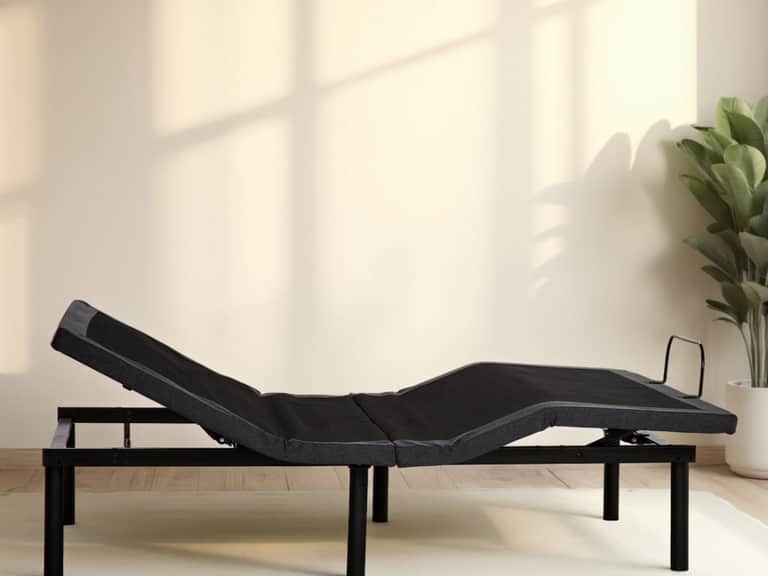
A specific example of a base with several adjustment features is the The Clean Bedroom (Level 3) Adjustable Bed Base. Its product information describes independent head and foot lifts, head tilt and adjustable-height legs, among other features. Those details illustrate why it is important to consider the base’s actual design. They do not, by themselves, establish compatibility with any particular latex mattress; verify the mattress model and base requirements directly before pairing them.
Keep the operating environment in mind, too. Bedding, mattress protectors and accessories should not interfere with movement or cover any controls, joints or safety mechanisms. Follow the manuals for placing and securing the mattress, and keep hands and objects clear of moving sections while the base is in operation.
Warranty and care deserve a close reading
Compatibility is not only a question of whether the bed moves. It can also affect the terms under which the mattress is covered. Warranty documents may specify the type of support surface required, identify disallowed uses or describe conditions for a claim. Read those terms before purchase; do not assume that a mattress warranty remains unchanged when a non-approved base is used.
Look for instructions on handling and care. A mattress may have rules for rotating, lifting, transporting or cleaning it. Follow those instructions when setting it up on an adjustable frame. Avoid bending it by hand to imitate the base’s motion or using the frame in a way the manufacturer has not approved. If the mattress shifts during adjustment, stop and check the manuals rather than repeatedly operating it in the same way.
Keep receipts, model numbers, manuals and any written support responses in one place. If a concern develops, these details help identify the products and determine whether the setup follows the instructions. When contacting support, describe what the base does, how the mattress is positioned and what guidance you have already checked. Do not continue operating a combination that appears damaged or behaves unexpectedly.
A practical checklist before you buy
Before ordering a natural latex mattress for an adjustable setup, use this checklist to turn a vague compatibility question into a set of answerable ones:
- Identify the exact mattress. Record its model, size and version. Similar names do not guarantee identical construction.
- Find direct approval. Confirm that the manufacturer permits the mattress to be used on an adjustable base.
- Check construction limits. Review thickness guidance and any restrictions related to layers, covers or support components.
- Read the base manual. Verify mattress dimensions, weight limits, setup rules and the base’s intended use.
- Confirm both sides agree. If either maker’s documentation is unclear, ask for an answer about the exact pairing.
- Review warranty conditions. Check what the mattress and base warranties require and what could affect coverage.
- Plan for safe setup. Follow assembly, placement and operation instructions; avoid improvised bending or modifications.
- Keep documentation. Save manuals, receipts and written responses for future reference.
This checklist is especially useful when shopping across categories. In the Natural Latex Organic Mattresses category, for example, a shopper may compare material credentials, comfort preferences and construction. Add adjustable-base approval to that comparison as a separate, non-negotiable question. A desirable material profile cannot make up for missing compatibility guidance.
What to do after installation
Once the manufacturers’ requirements are satisfied, set up the mattress and base exactly as directed. Check that the mattress is centered and supported, that cables and surrounding bedding are clear of moving parts, and that the bed is installed on the specified surface. If the base includes preset positions, consult its instructions before using them.
Operate the base gradually and observe the mattress as it moves. This is not a substitute for written approval, but it can help reveal an installation problem, such as the mattress sliding or an accessory catching. If anything appears strained, shifts unexpectedly or makes an unusual sound, stop. Return the bed to a safe position if the manual permits, then consult the manufacturer rather than forcing the mechanism.
Use the bed within its stated limits. Do not add unsupported extensions, alter the frame or use the mattress in a configuration that the maker excludes. When moving the base or mattress, follow the lifting and handling guidance; adjustable bases can be heavy, and mattresses may require more than one person to move safely.
Common assumptions that can mislead
“Latex is flexible, so it must work.” Material behavior is only one part of the finished mattress. Construction and explicit compatibility guidance matter.
“It bends when I press on it.” A brief hand test does not reproduce the geometry, support or repeated movement of an adjustable base. Do not use forceful bending as a test.
“The base is universal.” A base may accommodate many products while still having limits. Read its model-specific instructions and verify the mattress separately.
“The mattress is organic, so the frame should not matter.” Organic or natural material claims do not establish mechanical compatibility. Treat material sourcing and base suitability as distinct questions.
“A retailer’s general assurance is enough.” General guidance can be a helpful starting point, but confirmation should identify the exact mattress and base and account for their manufacturers’ terms.
The bottom line
A latex mattress may be capable of bending with an adjustable base, but no shopper should assume that every latex model is suitable. The answer depends on the finished mattress, its dimensions and construction, the base’s movement and limits, and the warranty and care instructions that govern both products.
Begin with the documentation. Check the exact mattress model, read the adjustable base manual, compare the stated requirements and contact the manufacturers when anything remains uncertain. That small amount of research can prevent a costly mismatch and provide a clearer path to using the bed as intended.
In practical terms, the right question is not simply, “Does latex bend?” It is, “Is this mattress approved to move with this base, under these conditions?” Get that answer before buying or operating the combination, and let product-specific guidance—not material assumptions—make the decision.